
Child Development
Developmental milestone charts highlight typical behaviors at various age intervals, but they are not exhaustive and can vary from one child to another. This list serves as a general guide to help caregivers understand the typical stages of a child’s development.
0-3 Months
- Startles in the presence of loud sounds
- Cries differently when tired, hungry, or in pain
- Grasps an object when placed in hand
- Attempts to reach for object but often misses
- Recognizes familiar objects and people
- Maintains fixed gaze at objects of interest
- Follows a moving object or person with eyes
- Moves eyes toward light and sound
- Vowel like sounds begin to emerge in the form of cooing, gurgling, and sighs
- Begins to attempt imitating speech by vocalizing

3-6 Months
- Sits with support
- Smiles at familiar people
- Giggling emerges, typically seen when playing with a toy or reacting to a caregiver
- Bangs objects when in hand
- Turns head when their name is called
- Vocally expresses excitement (at the sight of a toy or a familiar person)
- Makes noises when spoken to
- Babbling begins ("aga," "baba")
- Babbles to self, toys, or people
- Pitch and inflection in babbling develops
- Sound 'm' is produced by pursing lips together
- Attempts to imitate sounds

6-9 Months
- Sits without support
- Moves around by crawling
- Explores objects with hands and mouth
- Drinks from a cup
- Recognizes names of family members and shows interest in pictures
- Cries when parent leaves the room
- Giggles during joyful moments
- Attempts to imitate familiar sounds and actions
- Begins to respond to 'no'
- Babbles chains of sounds in reduplicative manner ("ma-ma-ma," "aba-ba-ba")
- Imitates intonation and speech sounds
- Sounds that appear in babbling include; m, n, t, d, b, p, y

9-12 Months
- First steps appear with assistance
- Begins to use objects correctly and finds hidden objects
- Play develops to exploratory phase (e.g., banging objects together, feeling, mouthing, throws toys with intent)
- Claps hands
- Expands arms to be picked up
- Responds to 'no' by pausing/stopping briefly
- Responds to simple verbal instructions (e.g. Give me, clap hands)
- Responds to simple questions by with searching movements
- Produces some vowel sounds ("oh," "ow")
- Combine sounds in syllable structures ("ma," "ba")
- First true words may appear closer towards 12 months
- Uses 1-10 words and gestures to communicate ("uh-oh," "mama," "daddy")
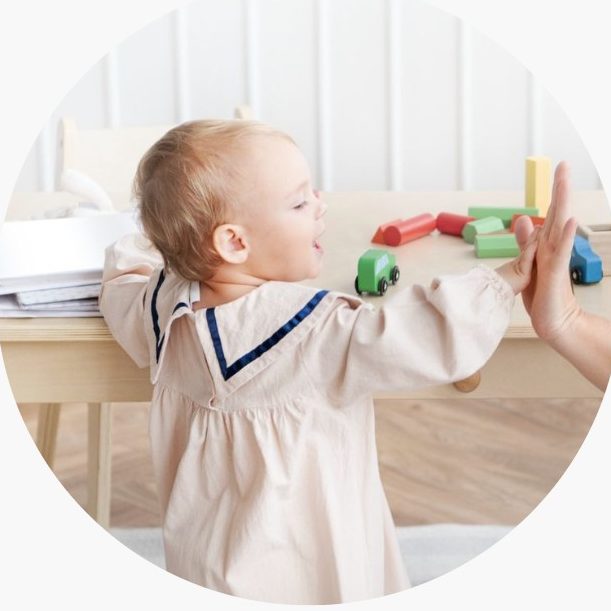
1-1½ Years
- Engages in continual movement, running emerges
- Functional play develops to intentional use of toys/object
- Placing objects in and out of containers
- Attempts to get toys out of reach
- Carrying/relocating objects from one place to another
- Scribbling with a crayon
- Attends to a book or a toy for 2 minutes
- Brings object to show adult
- Imitates many actions and activities
- Follows simple 1-step directions
- Points/reaches for objects of desire or when named
- Uses sentence-like intonations known as jargon
- Produces incomplete words ("go" for goat)
- Pointing and vocalizing commonly seen at this stage
- Uses 3-50 words, combinations of 1 to 2 words begins to emerge (e.g., "thank you," "big ball")
- Speech is mostly hard to understand
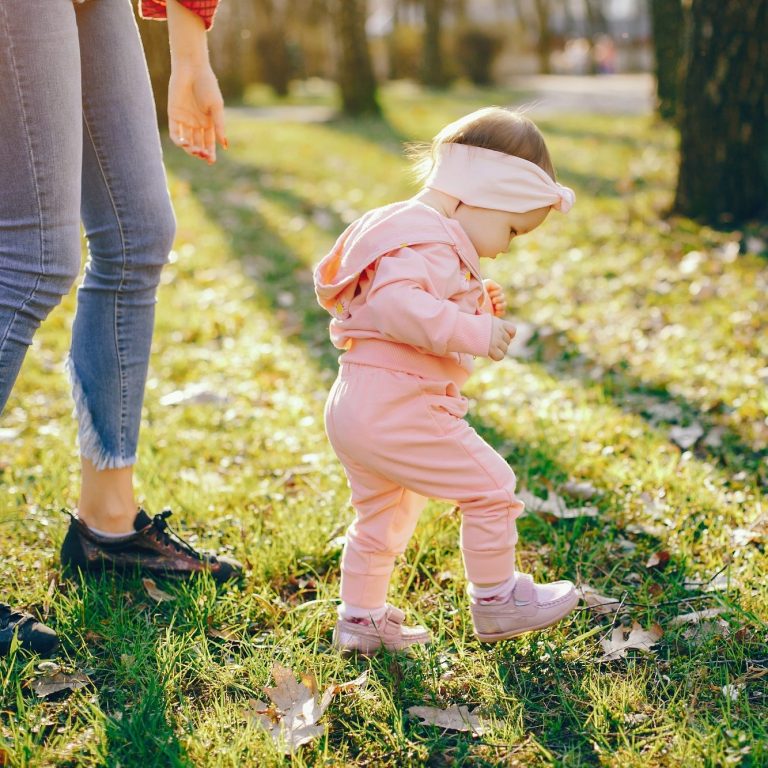
1½-2 Years
- Can climb on and off furniture
- Walks without assistance
- Can kick and throw a ball
- Object permanence fully acquired (Child searches for an object that was placed out of their plane of sight)
- Begins to show defiant behavior
- Identifies common objects/pictures and body parts by pointing, reaching, or grasping
- Begins to follow directions with spatial concepts (e.g., Put it in, Pick it up, Where is it?)
- Uses more words than gestures around 24 months
- Says name when asked
- Names objects and pictures
- Verbal turn-taking emerges
- Begins to combine 2+ words together (e.g., "doggie eat," "more apple," "mommy, car gone")
- Makes comments about immediate events (e.g., "oh no," "cat sleep")
- Can respond "yes" and "no" verbally or gesturally (headshake, head nod)
- Uses 50-200 words by 24 months (some may be made up words)
- Unfamiliar people can understand 25-50% of the child's speech
2–2½ Years
- Joint play begins to develop
- Play develops meaning and can be carried out in sequence (e.g., arranging furniture in a doll house; cooking, feeding, then putting a doll to sleep)
- Language starts to develop complexity as the child learns new concepts
- Articles (a and the)
- Present markers (-ing)
- Contractions (don't, can't, it's, that's)
- Pronouns (I, you, me)
- Names some objects by their use (e.g., What do we sleep on? What do we eat with?)
- Combines 2-3 words to make sentences (e.g., "girl is sleeping," "cats in box")
- Uses 200 words that others can understand
- Answers "What doing?" "What do you hear with?" and "Where" questions
- Family members can understand 50-75% of the child's speech
- Uses sounds m, n, p, b, t, d, h, and w in speech
- Sounds ng, k, and g are emerging
- May change or omit some sounds (e.g., "pay" for play, "fog" for frog, "deew" for deer)
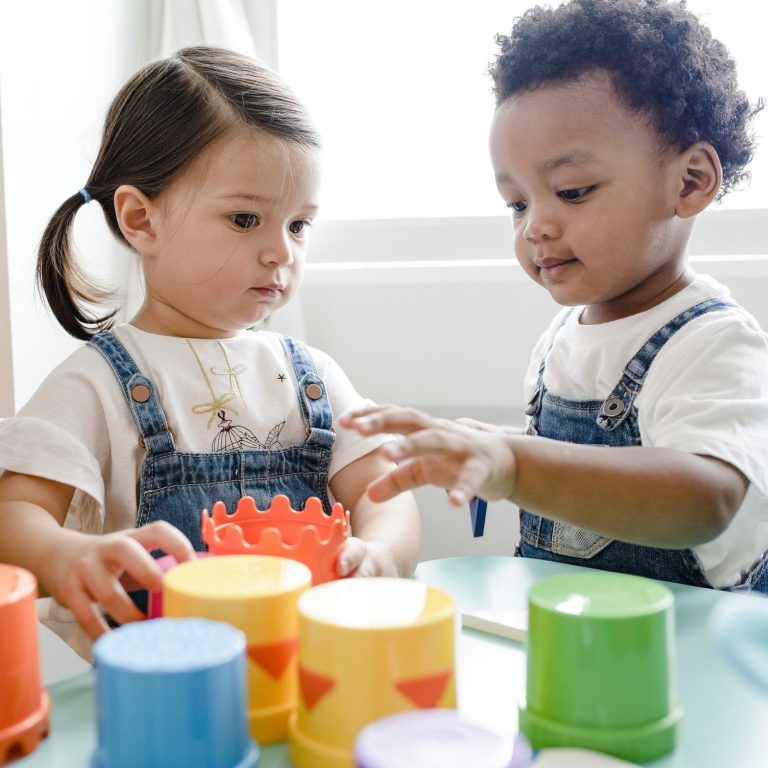
2½-3 Years
- Plays with other children
- Play develops more complexity
- Pretend or imaginary play emerges
- Beginning interest in interactive play with others
- Sharing/exchanging of toys with others
- Develops sequence awareness (e.g., bedtime or meal routines)
- Knowledge of concepts expands
- Spatial: in, on, under
- Descriptive: big, blue, round
- Quantitative: one, all, more
- Negation concepts emerging ("Show me the one that is not green," "Is the dog sleeping?")
- Use of proper grammatical markers in simple sentences emerging
- Auxiliary: I am hungry, He is sleeping
- Regular past tense appears: Walked
- Possession: daddy's
- Uses pronouns: I, me, you, mine,
- Emerging pronouns: he, she, it
- Answers simple "Where," "Who," "Why," and "How many" questions by age 3
- Begins asking simple questions ("What's that?")
- Uses 250-400 words
- Combines 3-4 word sentences ("I want to play," "He's swimming," "Go get it")
- Repeats sentences consisting of 6-7 syllables accurately
- Family members can understand 50-80% of the child's speech
- Sounds mastered at age 3: p, m, w, h, n, b
- Some distortions of sounds are present
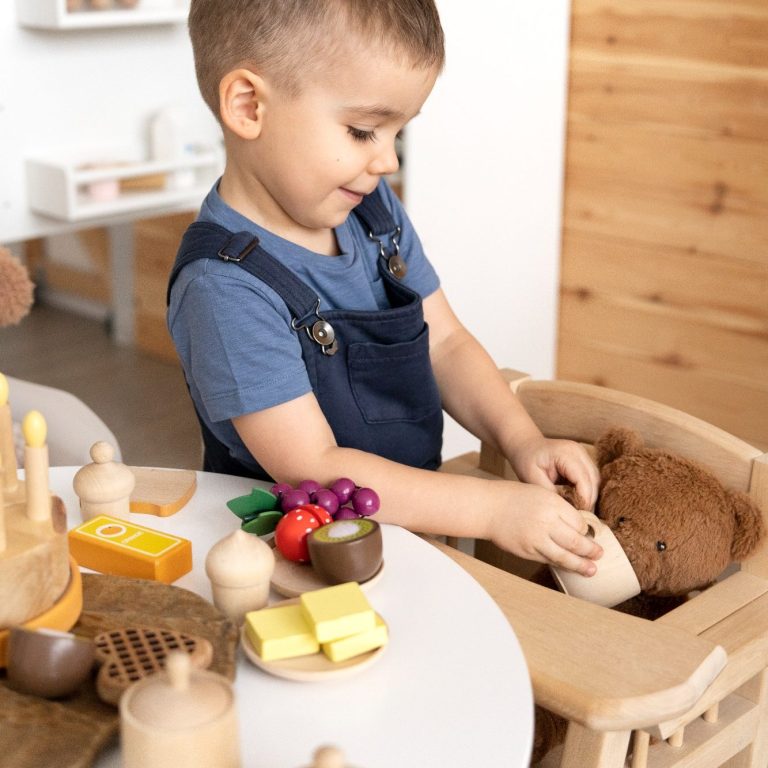
3-3½ Years
- Cooperative play emerges
- Initiates play/activities with caregivers or peers
- Reenacts events from previous experiences (e.g., birthday party)
- Use of proper grammatical markers expands
- Third person singular: He runs
- Contracted forms: won't, can't
- Irregular plurals emerge: children, feet
- Uses conjunction: and
- Attempts at telling stories appear
- Can answer more complex questions ("What do you do when you're hungry?")
- Completes sentences ("Animals live in the ______")
- Uses 800 words
- Combines 4-5 word sentences
- Compound sentences emerge ("He goes and he is running")
- Speech becomes more clear to unfamiliar people
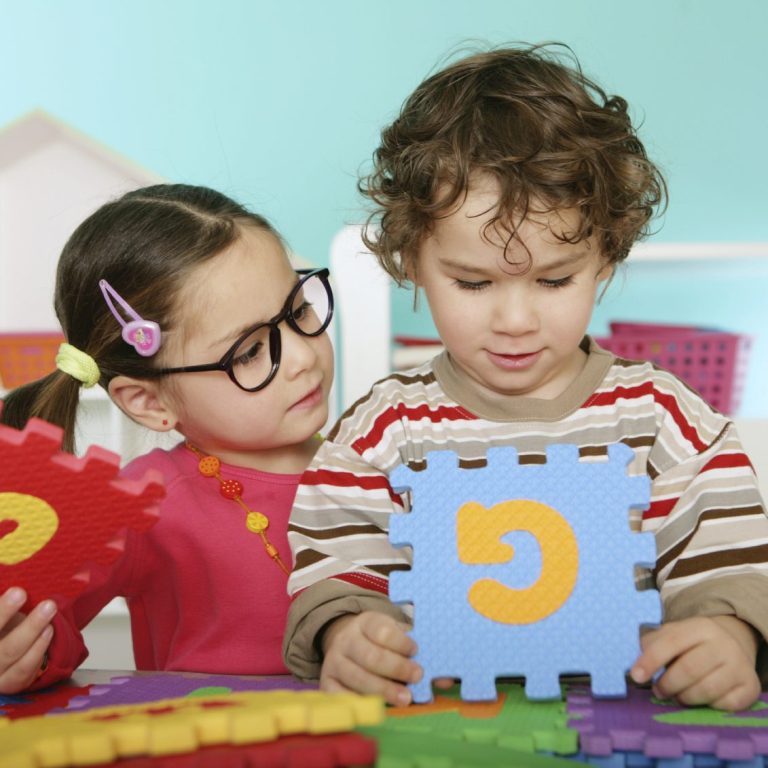
3½-4 Years
- Pretend play consists of two or more connected ideas
- Can operate mechanical toys (e.g. remote controlled toy cars)
- Enjoys playing with a group of children
- Role-play emerges (May assume a role of another person; superhero)
- Understands the concept of groups that items belong to
- Use of proper grammatical markers expands
- Reflexive pronouns emerge: myself
- Conjunction emerging: because
- Uses negation consistently: He is not hungry
- Uses 'got' in sentences: I got it
- Begins to make jokes and may act silly at times
- Back and forth conversation emerging
- Can complete verbal analogies ("My hand is big and your hand is _____")
- Answers "How much," "How long," and "What if" questions
- Asks "How," "Why," and "When" questions
- Questions like "What was/were...." emerge
- Can tell stories consisting of real and make-belief events
- Uses 1,000-1,500 words
- Combines 4-5 word sentences
- Compound sentences emerge ("He is sleeping and she is running")
- Speech is 75-90% intelligible
- Consonants mastered at age 4: k, g, d, t, ng, f, y
4-4½ Years
- Imaginative play is developed
- Can identify missing parts in pictures
- Uses scripts in play schemas using dolls or figures
- Self-praises own behavior and completed projects
- Uses passive voice at times (The boy was chased by the dog)
- Answers more complex questions ("Why did you hide the doll behind the sofa chair?")
- Can describe something (e.g., How an object is used, what something looks like)
- Makes conversational repairs if the communicative partner did not understand and corrects others
- Uses primitive narratives and provides some background information for the listener
- Can maintain conversation for several turns and ends conversations appropriately
- Combines 4-7 words in sentences
- Speech is 90% intelligible in connected speech
4½-5 Years
- Fantasy play begins to develop
- Shows interest in exploring places
- May appear motivated with competition
- Begins to understand the concept of time
- Understands cause and effect and can respond to related questions
- Retells familiar stories or events from previous experiences
- Stories follow a sequence but not necessarily the main idea
- Discusses emotions or feelings with more detail
- Use of proper grammatical markers becomes more refined
- Understands and uses future tense: will
- Can define words
- Answers "Why" questions appropriately
- Combines 5-8 word sentences
- Speech is understood most of the time by familiar or unfamiliar listeners
- Understands speech sound errors and self-corrects
- Some difficult words may be mispronounced (hippopotamus, chandelier)
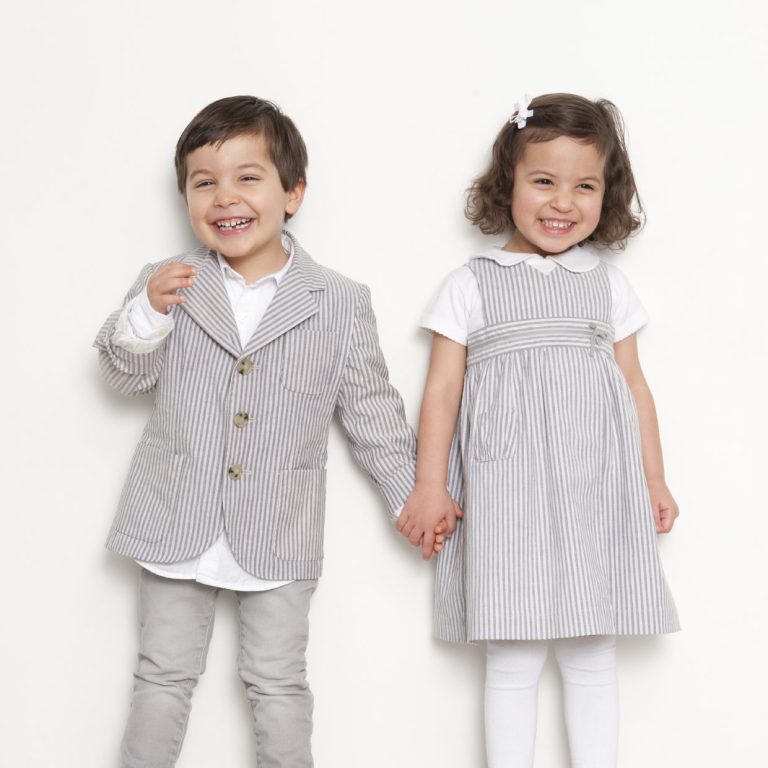
5-6 Years
- Appears more independent
- Can distinguish the difference between fantasy and reality
- Plays games based on rules and instructions
- Creates stories using imagination
- Asks permission for use of objects from others
- Uses polite markers ("Please," "thank you," "you're welcome") regularly
- Can describe similarities and differences of items
- Can relay name and address to others
- Grammar improves
- Uses all pronouns accurately
- Uses superlatives (bigger, biggest)
- Uses deictic terms correctly (this/that, here/there)
- Adverbs emerging (happily, slower)
- Can formulate compound and complex sentences
- Speech is 100% intelligible to unfamiliar listeners
- Sounds l and r are mastered by the age of 6

6-7 Years
- Enjoys interacting with clusters of close friends
- Can spend extended amount of time on one activity
- Sense of 'belonging' becomes important
- Begins to develop improved self-control
- May display increasing need for independence and privacy
- Understands more about feelings and relationships
- Use of slang may appear
- True narratives are well developed in this age group
- Provides varied information when asked
- Most grammatical markers are developed
- Use of if and so are developed
- Use of irregular comparatives properly: good, better, best
- Iteration emerges ("You have to go to bed early so you're not tired)

References:
Blume, J., Wittke, K., Naigles, L., & Mastergeorge, A. M. (2020). Language growth in young children with autism: Interactions between language production and Social Communication. Journal of Autism and
Developmental Disorders, 51(2), 644–665. https://doi.org/10.1007/s10803-020-04576-3
First Discoverers (2022, March 24). How to boost speech and language development in early years. First Discoverers. Retrieved November 5, 2022, from https://www.firstdiscoverers.co.uk/boost-speech-and- language-development-earlyyears/
Important milestones: Your baby by one year (2023) Centers for Disease Control and Prevention. Available at: https://www.cdc.gov/ncbddd/actearly/milestones/milestones-1yr.html (Accessed: 15 February 2025).
Kipping, P., Gard, A., Gilman, L., & Gorman, J. (2012). Speech and language development (3rd ed.). Austin, TX: PRO-ED.
Kleeck, A. van, Gillam, R. B., Hamilton, L., & McGrath, C. (1997). The relationship between middle-class parents’ book-sharing discussion and their preschoolers’ abstract language development. Journal of
Speech, Language, and Hearing Research, 40(6), 1261–1271. https://doi.org/10.1044/jslhr.4006.1261
Levickis, P., Conway, L., Smith, J., & Bennetts, S. (2022). Parent–child interaction and its impact on language development. Language Development, 166–192. https://doi.org/10.1017/9781108643719.010 Ma,
X., Shen, J., Krenn, H.Y. et al. A Meta-Analysis of the Relationship Between Learning
McLeod, S., & Bleile, K. (2003, November). Neurological and developmental foundations of speech acquisition. Seminar presented at the American Speech-Language-Hearing Conventio, Chicago, IL.
Outcomes and Parental Involvement During Early Childhood Education and Early Elementary Education. Educ Psychol Rev 28, 771–801 (2016). https://doi.org/10.1007/s10648-015-9351-1
Siyambalapitiya, S., Paynter, J., Nair, V. K., Reuterskiöld, C., Tucker, M., & Trembath, D. (2021). Longitudinal social and communication outcomes in children with autism raised in bi/multilingual environments.
Journal of Autism and Developmental Disorders, 52(1), 339–348. https://doi.org/10.1007/s10803-021-04940-x
Society for Research in Child Development. (2011, June 20). Early experience found critical for language development. ScienceDaily. Retrieved November 4, 2022 from
www.sciencedaily.com/releases/2011/06/110617081541.htm
Suttora, C., Zuccarini, M., Aceti, A., Corvaglia, L., Guarini, A., & Sansavini, A. (2021). The effects of a parent-implemented language intervention on late-talkers’ expressive skills: The mediational role of parental
speech contingency and dialogic reading abilities. Frontiers in Psychology, 12. https://doi.org/10.3389/fpsyg.2021.723366